

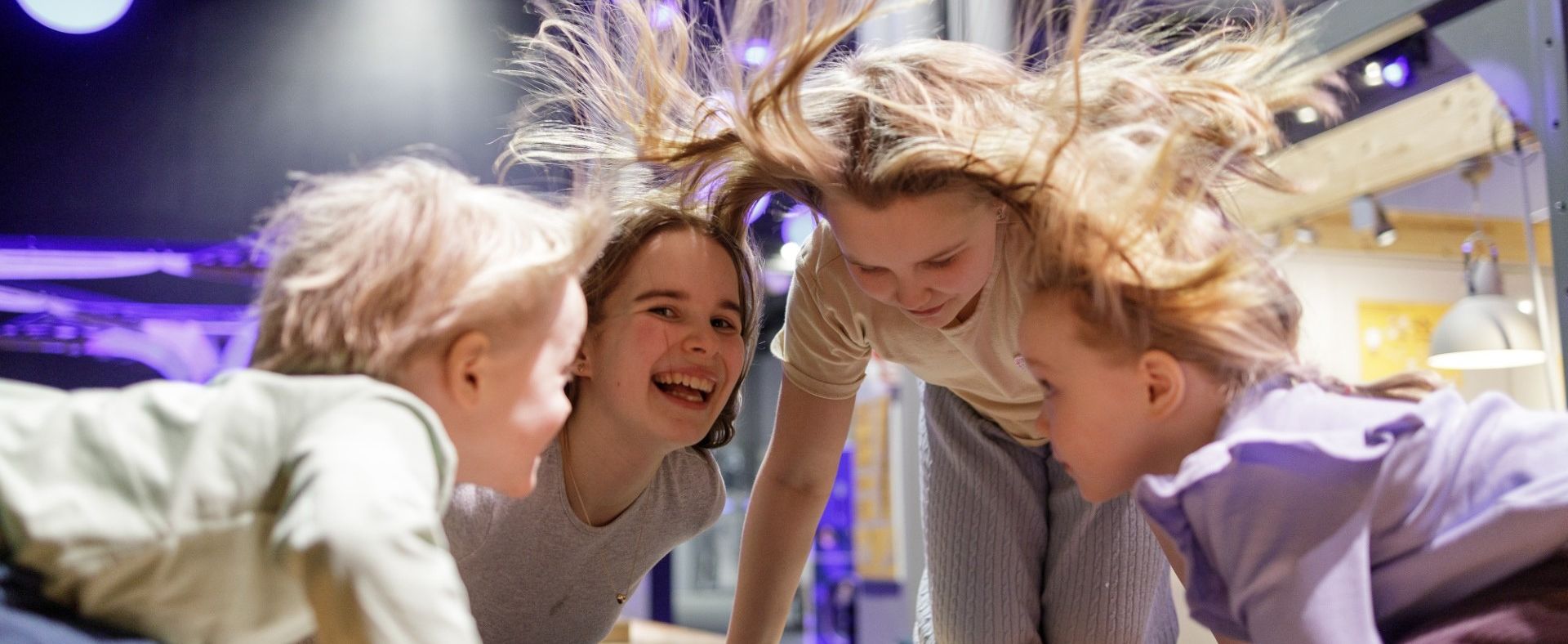
Seeing the World Through Science
The forces that hold bridges together, gravity, satellites or the development of writing. When have you found yourself wondering about, marvelling at or questioning the achievements of science?
Scientific knowledge is based on observations, experiments and rational reasoning. It is constantly evolving and being refined as new evidence emerges. In our society, scientific knowledge is reflected in the pursuit of progress, technological innovation and a willingness to question established ideas in the light of new evidence. Scientific thinking also plays an important role in our everyday decisions and in shaping our understanding of what is true and trustworthy.
The Finnish Literature Society (SKS), the Society of Swedish Literature in Finland (SLS) and Science Centre Heureka invite you to share your experiences of how a scientific worldview is reflected in everyday life.
Share your story by 15 May 2027 for a chance to win book prizes!
Since 1989, Science Centre Heureka in Tikkurila, Vantaa, has offered children and adults alike the joy of discovery and the excitement of science. Through hands-on activities and experiences, visitors have explored scientific achievements and possibilities, as well as the laws of nature that shape the world around us. Beyond its exhibitions, Heureka has opened up the world of science through its planetarium, science camps, laboratories, workshops and a wide range of events.
This collection is organised by the Finnish Literature Society (SKS), the Society of Swedish Literature in Finland (SLS) and Science Centre Heureka. Responses will be preserved in the SKS Archives, with electronically submitted responses also deposited in the Finnish Social Science Data Archive. Responses in Swedish will be preserved in the SLS Archives. The results of the collection will be announced in early 2028.
With your permission, your text or excerpts from it may be published in a non-fiction book celebrating Heureka’s 40th anniversary.
Questions to inspire your writing
You can use the following questions as a starting point:
- How do you distinguish everyday knowledge or gut feelings from scientifically established facts? What kind of evidence would you need to believe something entirely new or seemingly unbelievable?
- Are you more inclined to trust an individual’s personal experience or the findings of extensive scientific research? Why?
- Do you remember your first visit to Heureka? What stages of your life or particular exhibitions do you associate with your visits?
- Has Heureka influenced your relationship with science? Have you experienced something at Heureka that made you think differently or helped you see a scientific or everyday phenomenon in a new light?
How to reply
Write in your own language and style. There is no limit on the length of texts. We also accept photographs, past memoirs and interviews. Please only send material that you have the right or permission to send.
Please, indicate your consent for the archiving of the material you send under your name or anonymously in the SKS Archives.
Also, please indicate if you consent to the representatives of the Audible Future project contacting you for the purpose of recording.
Yes. If you are sending a reply by post or as an attachment, please include your name or pseudonym, contact details, date of birth and occupation. Please write your contact details on a different page from the actual reply.
Please, mark the envelope with identifier ‘Soundscapes’.
Photo: Heureka